


Signs of the Roman era
The Aosta Valley preserves some of the best-preserved Roman remains in the Alps: bridges, arches, walls, theaters, and paved roads that tell the story of the birth and development of Augusta Praetoria and the communication routes to Gaul.
From the Ou Crierel Hostel, you can easily set off to discover these unique places: from the Roman bridge at Pont-Saint-Martin to the Arch of Augustus, from the forensic cryptoporticus to the walls and towers of the city of Aosta, to the evocative stretch of Via delle Gallie in Donnas with its arch carved into the rock. A true journey through time, among history, panoramas and ancient architecture still perfectly integrated into the Alpine landscape.

Roman bridge
It is one of the most beautiful and best preserved in the Roman world, and the largest single-span bridge.

Arco sulla Via della Gallie
In Donnas, the paved section of road is overlooked by an arch cut into the rock, with a carefully crafted archivolt.

Arch of Augustus
It is the symbolic monument of Aosta. It was erected in 25 BC, the date of the founding of Augusta Praetoria (Aosta), in honor of Emperor Augustus’ victory over the Salassi.
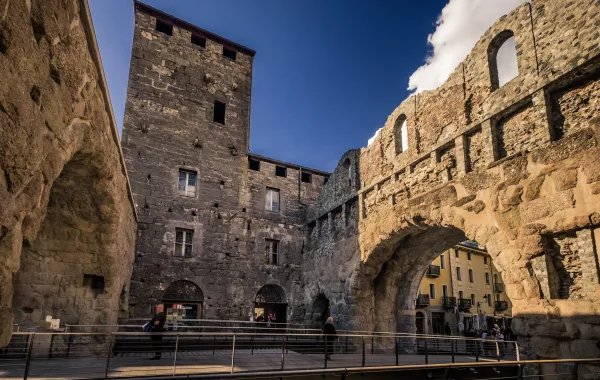
Porta Pretoria
It was the main entrance to the city. It has two parallel arches, 12 meters apart, each with three passages: one in the center for carts and two on the sides for pedestrians.

Forum and cryptoporticus
The cryptoporticus, which was part of the Forum complex, is a semi-underground gallery supported by mighty arches.

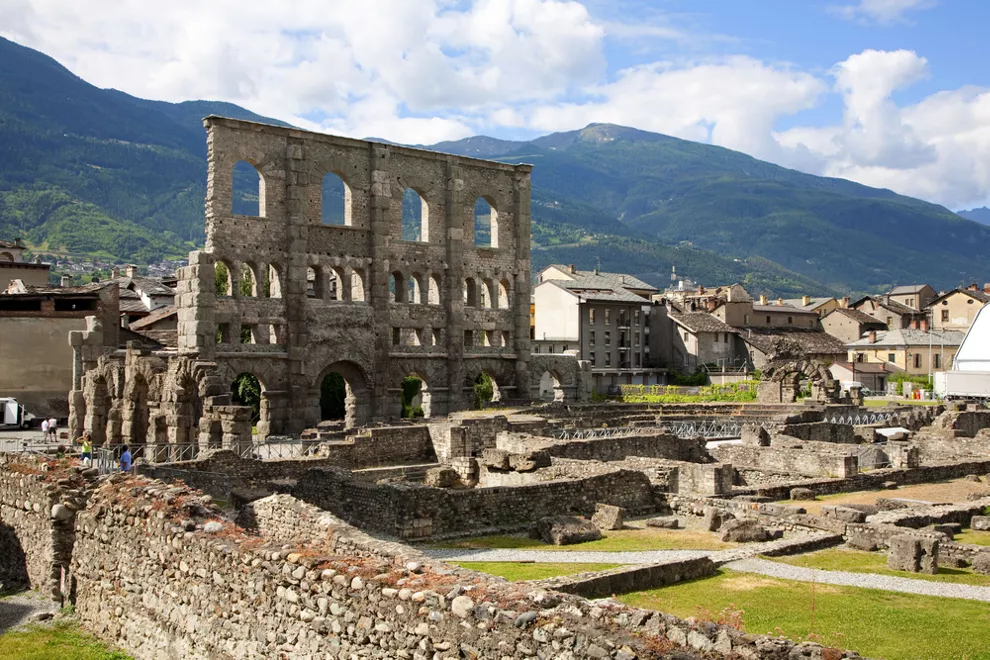
Roman theater
The imposing southern façade of the theater, which could hold three or four thousand spectators, is clearly visible at a height of 22 meters.

The city walls

Perimeter towers
At the corners of the walls and along the entire perimeter, at regular intervals, there were 20 square towers.